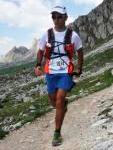
Per migliorare in salita bisogna considerare che ci sono 2 aspetti (principalmente) su cui poter incidere attraverso l'allenamento, lavorando sulla forza MASSIMA e sulla RESISTENZA alla forza:
- la capacità di "reclutare" una maggior percentuale di fibre muscolari (sia ad ogni passo che in assoluto, dato che dal pdv delle capacità "nervose" è necessario stimolare i muscoli a lavorare alla max intensità per interessare fibre che altrimenti non vengono quasi mai utilizzate)
- la capacità di tollerare una maggiore quantità di acido lattico (localmente nei muscoli) e la capacità di smaltire/ossidare l'acido lattico prodotto per tempi relativamente lunghi
Nel primo caso si può migliorare la Fmax attraverso allenamenti di SPRINT in SALITA (circa 10''/15'' alla max intensità - 60/80m circa) che mi obbligano ad utilizzare una maggior % di fibre ad ogni spinta, e soprattutto in condizioni di affaticamento vanno a richiamare fibre solitamente non utilizzate. Sedute tipo 10x60m rec 2' poi 3x(5x60) rec 2'/5'....poi 10x80...l'importante è fare sempre tutte le prove alla max intensità, essendo un tipo di lavoro rivolto appunto al miglioramento delle capacità "neuro-muscolari" è efficace solo se lo stimolo è massimo.
Dalla parte opposta dello "spettro", per migliorare la capacità di tollerare/smaltire l'acido lattico occorre innanzitutto lavorare sulle componenti aerobiche e quindi migliorare la RESISTENZA e la POTENZA AEROBICA (Lento,medio,fartlek, progressivo, ripetute medie e lunghe...cronoscalate con pendenze non eccessive) che mi permetteranno di innalzare la soglia anaerobica (quindi correre ad una intensità più alta in condizione di semi-equilibrio nell'accumulo di acido lattico).
Quindi si potrebbe iniziare accoppiando ogni settimana questi 2 tipi di lavori, uno breve ma molto intenso e l'altro più lungo ma ad intensità minore, magari abbinando un terzo allenamento di esercizi a carico naturale per tutti i distretti muscolari....e poi pian piani creare un "imbuto" in cui:
- allungo la durata/lunghezza degli sprint in salita (da 10x60 >> 10x80 >> 10x100 >> 10x150 rec da 2' a 4'...)
- velocizzo/intensifico l'allenamento di salita lunga (4>6>8>10km di cronoscalata o collinare oppure sempre la stessa distanza ma correndo un po' più veloce....pendenza al di sotto del 10% però)
Con questo metodo arriverò gradualmente a lavorare sulla RESISTENZA SPECIFICA per il trail, ESTENDENDO l'intensità ed INTENSIFICANDO la durata, e quindi agirò su componenti quali la RESISTENZA/CAPACITA' LATTACIDA (sostenute però da un lato da migliorate componenti "meccaniche" di Fmax su cui avrò lavorato con gli sprint brevi, dall'altro da migliorate capacità "metaboliche ed enzimatiche" su cui ho lavorato attraverso l'allenamento di corsa prolungata e/o variata e i collinari/cronoscalate).
L'obiettivo finale potrà essere appunto quello di effettuare allenamenti di frazionati ad intensità medio-alta su salite abbastanza impegnative (la distanza e il D+ dipendono dal tipo di gara che si prepara....) e anche come già detto abbinare SALITA e DISCESA (però con cautela visto che quest'ultima provoca molto più stress a livello articolare e muscolare, quindi necessita di condizioni di freschezza e di maggior recupero post-allenamento)
alcuni spunti:
http://www.letsrun.com/forum/flat_read. ... 360&page=0
Short hill sprints have the final goal to help to recruit the most part of fibres in your muscles. That's the reason because is an important training NOT CONNECTED with the distance of the event, but with a physiological target.
Normally, I use this work as second training of the day, after a long run (may be 1:15 - 1:30) at good pace, but not too much fast (in the case of Marathon runners of 2:08, for example, about 5:30 / 5:40 per Mile pace).
Of course, if there are athletes training once a day only, we cannot use short sprint as full training session.
The development of this training (that remains for all the season, without any difference between general period and specific period) is to move for longer distances (for example, 10 x 150 or 10 x 200), only after reaching a very good level of speed and specific speed endurance (not before 2 months of short sprints). In this way, we can move from a MECHANICAL and NERVOUS goal, to a METABOLIC goal, maintaining the other goals too.
I see many people make confusion between the different distances, nothing to do with SHORT sprints. The common denominator is not the fact that different distances are on the hill, but that the speed MUST BE at 100%, because our final goal is TO RECRUIT THE HIGHEST PERCENTAGE OF FIBRES.
We don't want to produce lactate (little quantity only, that is possible to remove using the OXYDATIVE SYSTEM, so short sprints uphill are an AEROBIC WORKOUT, according to the researches of Finnish scientists Vikho and Komi, together with the Italian Carmelo Bosco),but look for a NERVOUS goal.
How many sprints an athlete have to do ? You have to control your time on the same distance, for example 10.0.
When you are no more able to run close to that time because you feel nervously tired and exhausted, is time to stop. BECAUSE IT'S IMPORTANT TO RUN AT MAX SPEED, recovery time is not important.
Of course, we use also long hills (200 - 400 and also 600m), but the final goal and their mean is completely different.
We must have PHYSIOLOGICAL goals in our training, not mixing a lot of things without knowing the effects on your body. Remember that the reason because you can run faster after a period of good training is that THIS TRAINING GOES TO MODIFY YOUR PHYSIOLOGY, so your final values (for example, of the blood) become different.
Don't forget we have 2 different engines :
a) The MECHANICAL engine, producing work (muscles etc.), that means we have to take care of our muscular power in all the particulars
b) The ORGANIC engine, that must allow an athlete in lasting at high intensity for long time. In this case, we go to provoke enzymatic and mythocondrial changes in our body, changing our METABOLIC ability.
Different is to use specific CIRCUITS uphill for increasing the STRENGTH ENDURANCE.
For example, sprint 60m + 40m bounding + 60m sprints + 40m heels-to-buttocks + 60m sprinting + 40m skipping + 100m sprint at max intensity, and when you stop 10 times squat-jump using the max energy you can (400m climbing).
In this case, we have to use the max intensity, and recovery must be very long, because your fibres become full of lactate.
For increasing in the final sprint, you must increase your ability in RECRUITING FIBRES already full of lactate, nothing to do with the max speed you have.
The use of circuits for strength endurance has exactly this final goal : to enhance the ability in recruiting fibres already saturated of lactate.

 ) ripide. L'esercizio diventa a prevalenza anaerobico e dopo la salita mi ritrovo con le gambe di legno.
 ) a tutti.